There's a version of running an online business that looks like this: orders coming in consistently, inventory always accurate, customers returning on their own, and your data actually telling you something useful. It doesn't feel frantic. It feels like a business.
Then there's the version most sellers are actually living reactive, scattered and constantly putting out fires.
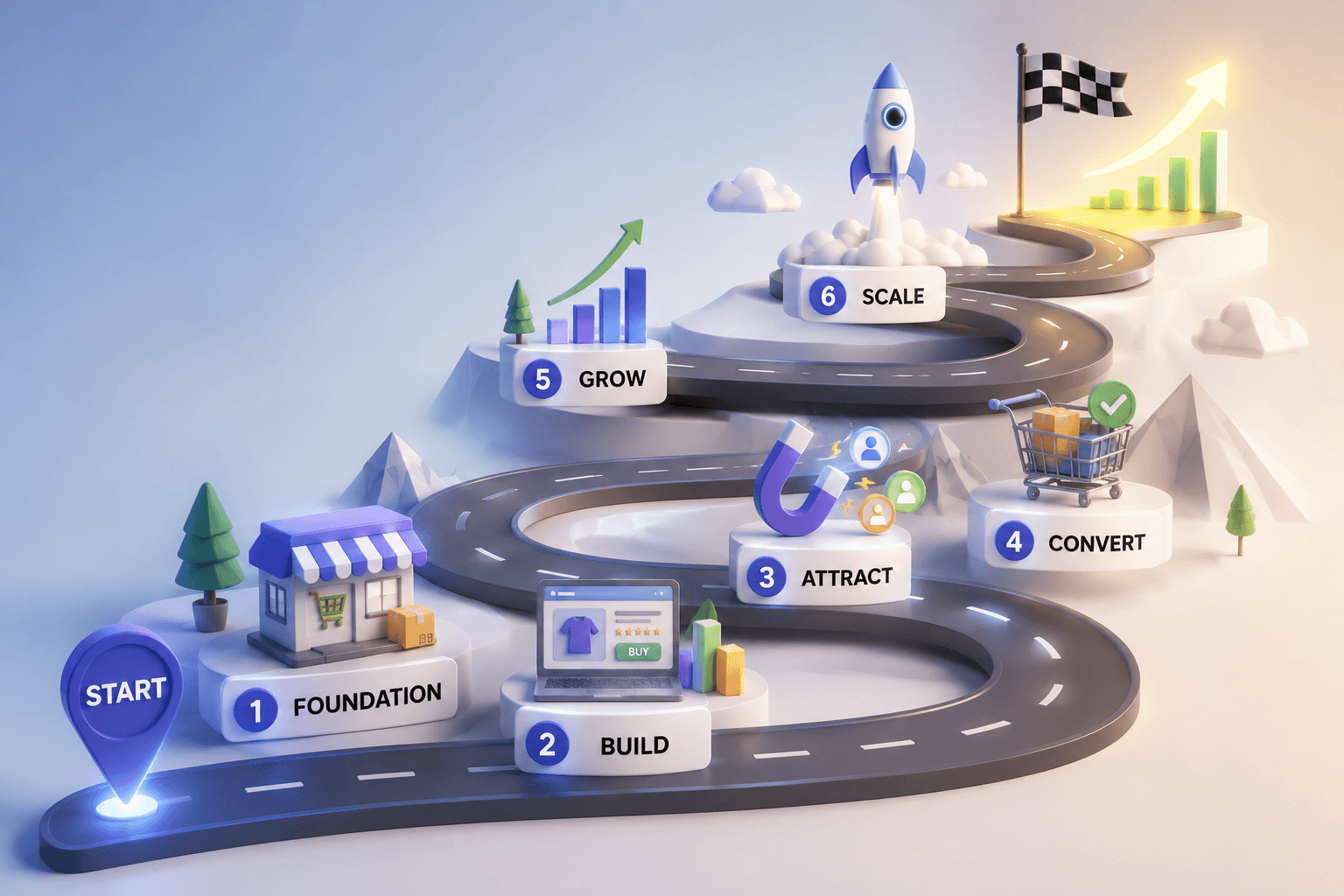
The gap between those two versions isn't talent or luck. It's a strategy. Specifically, it's having an online business growth roadmap that you actually follow, built around how Indian eCommerce is moving in 2026.
This guide is that roadmap. Whether you're a solo seller running an Instagram boutique, a growing D2C brand trying to scale, or a home business that's ready to stop depending on marketplaces, what follows is the most practical eCommerce strategy for 2026 you'll find. No fluff, no generic advice. Just a stage-by-stage plan for how to grow your online store in a way that actually holds up.
Why Most Growth Advice Fails Indian Sellers
Before we get into the roadmap itself, it's worth naming something that rarely gets said: most eCommerce growth content is written for Western markets. It assumes you're on Shopify, advertising on Facebook with a big budget, and shipping to customers who pay by card.
That's not the reality for most Indian sellers. Your customers pay by UPI. A significant chunk still wants cash on delivery. GST billing matters. WhatsApp is a sales channel, not just a messaging app. Instagram is where discovery happens. And the platforms that "everyone" recommends often aren't built for how business actually works here.
The roadmap below is built specifically for the Indian context for sellers who want to grow online without Amazon, without Flipkart taking a margin, and without needing a developer or a ₹5 lakh budget to get started.
Stage 1: Build the Right Foundation (Months 1–2)
Every strong growth strategy starts with foundations that can actually carry the weight of scale. Skip this stage, and everything you build on top becomes fragile.
Own Your Storefront
If you're still selling only through a marketplace or Instagram DMs, this is the year to change that. The risk of depending entirely on another platform is real algorithm changes, account restrictions, marketplace fee increases. None of these are in your control.
Building your own website isn't the complicated, expensive project it used to be. An affordable eCommerce platform in India designed for sellers like you means you can have a fully functional online store with UPI, Razorpay, and cash on delivery built in without writing a single line of code.
For Instagram sellers specifically, the move to your own website is the single highest-leverage decision you can make in 2026. You get to convert Instagram followers to customers on a platform you own, capture their email and contact details, and build a relationship that Instagram's algorithm can't take away from you.
A proper online store for your Instagram boutique, saree business, jewellery brand, or fashion label doesn't replace your social presence, upgrades it. Your link in bio becomes a link to a real store, not just a DM request.
Set Up Your Product Catalogue Properly
This sounds basic, but poor product catalogue management is one of the most common reasons Indian sellers hit a wall early. When your catalogue is incomplete, missing variants, vague descriptions, no consistent pricing every order is a potential problem.
Spend time here. Every product should have clean images, accurate stock counts, size or variant options properly listed, and pricing that accounts for your actual costs including GST. This becomes the single source of truth for your entire operation. When your catalogue is clean, everything downstream orders, inventory, customer service becomes significantly easier to manage.
Sort Your Payments and Compliance
In 2026, there's no excuse for a clunky checkout. UPI, cards, wallets, buy-now-pay-later, cash on delivery your customers have preferences, and if your checkout doesn't meet them, you lose sales before they happen. An eCommerce website with GST billing built in also saves you hours every month and keeps you compliant without thinking about it.
Stage 2: Systematise Your Operations (Months 2–4)
Once your store is live and your catalogue is clean, the next challenge is keeping up with what comes in. This is where most growing businesses start to crack not because they don't have customers, but because their operations can't handle the volume.
Get Serious About Inventory Management
Manual inventory tracking spreadsheets, memory, handwritten notes works until it doesn't. And when it stops working, it stops suddenly. You oversell a product, a customer is disappointed, you get a negative review and you spend twice as long fixing the fallout as you would have spent doing it right in the first place.
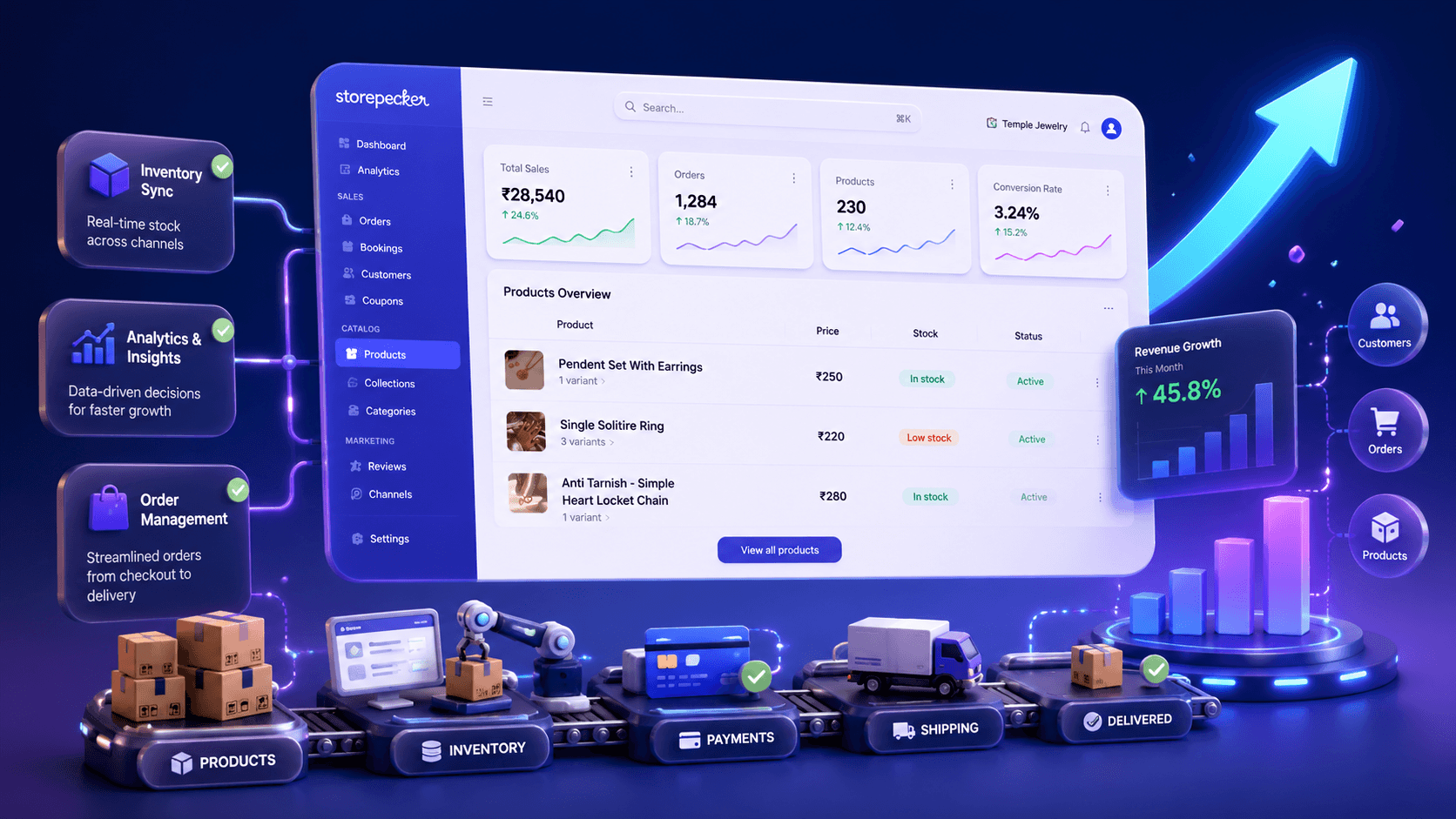
Inventory management for your online store should be automated at this stage. Every sale should reduce your stock count in real time. Low-stock alerts should fire before you run out, not after. If you're selling across your own website and through social media, your inventory needs to reflect that everywhere, not just in one place.
For sellers managing multiple variants (think saree sellers with different fabrics and colours, jewellery sellers with different metals and stones, fashion boutiques with sizes and prints) proper variant-level inventory tracking isn't optional; it's what keeps your business honest.
Build an Order Management System That Actually Works
When orders come in from different sources on your website, Instagram, WhatsApp without a central order management system for your Indian online store, you're manually piecing together what needs to be packed, shipped and tracked. That's fine at ten orders a week. It's not fine at fifty.
A centralised order management system shows you everything in one view: what's pending, what's been packed, what's out for delivery and what's been delivered. It removes the need for you to hold all of this in your head, which frees up mental space for decisions that actually matter.
WhatsApp selling is a real channel for Indian sellers and will remain so in 2026. The best systems bridge this your WhatsApp orders don't live in a separate universe from your website orders. They flow into the same pipeline.
Stage 3: Use Data to Make Smarter Decisions (Months 3–6)
This is the stage that separates sellers who grow steadily from sellers who grow and then plateau. Data isn't something only large businesses need. It's something every business needs as soon as they want to stop guessing.
Actually Use Your Analytics Dashboard
An eCommerce analytics dashboard isn't just a graph that looks impressive in screenshots. It's how you answer questions that drive growth: Which products are selling the most? What's my repeat purchase rate? Where are my customers coming from? What days do orders spike? Which products are being viewed but not bought?
When you can see this clearly, you stop making decisions based on instinct alone. You know which product to restock before it runs out. You know which marketing channel is actually working. You know whether the sale you ran last month actually improved your margins or just moved the same volume at a lower price.
In 2026, eCommerce analytics for small businesses in India will no longer be a premium feature. It's a baseline expectation. If your current platform isn't showing you this data, that's a platform problem not a you problem.
Let AI Do the Heavy Lifting
AI-powered online store management is not science fiction anymore. It's practical, available, and increasingly the reason some sellers are outpacing others who have similar products and similar marketing budgets.
What does AI actually do in an eCommerce context? It flags when your inventory is trending toward zero before you notice. It identifies which products are underperforming and why. It helps with product descriptions, customer communication, and demand forecasting. For D2C brands in India specifically, AI eCommerce tools are increasingly being used to personalise the shopping experience showing customers what they're actually likely to buy rather than a generic homepage.
Smart eCommerce platforms for growing brands in India are building these tools at the platform level. You don't need a separate AI subscription or a tech team. You need a platform that's built for this.
Stage 4: Build Your Brand and Grow Retention (Months 4–8)
Traffic and conversion matter, but retention is where the actual margin lives. Acquiring a new customer costs several times more than retaining an existing one. Yet most sellers pour their energy into getting new customers while doing almost nothing to bring the old ones back.
Own Your Customer Relationship
The biggest structural advantage of having your own website over selling on a marketplace is data. When you sell on Amazon or Flipkart, they own the customer relationship. You don't know who bought from you, you can't contact them, and you can't bring them back without paying the marketplace again.
When you sell directly to customers through your own store or D2C website you own that data. You can email them. You can run WhatsApp campaigns. You can offer loyalty discounts. You can ask for reviews. That relationship compounds over time, and it's one of the most valuable assets your business can build.
This is why the own brand store vs marketplace debate isn't really a debate anymore for sellers who want to build something long-term. Marketplaces are for discovery. Your own store is for building a brand.
Make Repeat Purchases Easy
In 2026, the best eCommerce growth tools for Indian small businesses focus heavily on post-purchase experience. Order confirmation messages, delivery updates, easy returns, personalised follow-up offers these are the moments where customers decide whether they'll come back.
A returning customer who had a smooth experience is also your most effective marketing channel. They tell people. They share your products. They leave reviews. You don't have to do anything except make sure the first experience was good enough to earn the second.
Stage 5: Scale With Systems, Not Just Effort
The final stage of the roadmap is the one most sellers never reach, not because their business isn't good enough, but because they burn out managing growth that their systems weren't built to handle.
Scaling without the right infrastructure just means more of the same chaos, faster. More orders piling up. More inventory mistakes. More customer service issues. More late nights.
Scaling with the right infrastructure looks completely different. Your order management handles the volume automatically. Your inventory updates across every channel in real time. Your analytics tell you where to double down. Your AI tools flag the issues before they become crises.
For Indian sellers who want to scale their D2C business online, grow an online business without a marketplace, or take a fashion boutique or home business to the next level, the platform underneath all of this matters enormously. You need something built for India, built for how you sell, and built to grow alongside you.
The Sellers Who Will Win in 2026
Here's what the next twelve months look like for Indian eCommerce: more competition, more sophisticated customers, and more tools available to sellers than ever before. The gap between sellers with good systems and sellers without them is going to widen.
The sellers who win won't necessarily have the biggest budgets or the flashiest branding. They'll be the ones who own their customer relationships, run clean operations, make data-driven decisions, and use smart platforms to do more with less.
That's what this online business growth roadmap is designed to help you build. Not overnight, not all at once but stage by stage, in an order that makes sense for where you actually are right now.
You don't need to figure all of this out on your own. The right platform should do a significant portion of this work for you, automatically, in the background, while you focus on the parts of your business that actually need your attention.
Build your growth plan with Storepecker - the eCommerce platform made for Indian sellers who are serious about 2026. From your first product listing to full-scale D2C operations, Storepecker gives you the store, the tools, and the data to grow online on your own terms.
Your roadmap starts here.