Running an online store sounds exciting until you're actually doing it. You're juggling product listings, tracking inventory, chasing orders, replying to customer messages on WhatsApp, updating your Instagram page and somehow trying to figure out why sales dropped last Tuesday. If you've ever sat at your desk at 11 PM wondering how to keep all of this under control, you're not alone.
eCommerce management challenges are real and they hit hard especially for independent sellers, small business owners, and growing D2C brands in India who are trying to do everything themselves. The good news? Overwhelming doesn't have to be permanent. There's a smarter way to run your store and it starts with understanding exactly what's breaking down.
The Real Reason eCommerce Feels So Hard
Most sellers don't fail because they have a bad product. They struggle because the backend of their business becomes a tangled mess that nobody warned them about.
When you first start selling maybe from Instagram, maybe through WhatsApp, maybe by listing on a marketplace the process feels manageable. A few orders a day, a spreadsheet or two, and you're sorted. But as your business grows, the cracks start to show.
Suddenly you're getting orders from your Instagram page, your own website, and WhatsApp all at once. Your inventory lives in your head. You have no clean way to track what sold, what's low on stock, or what your best-performing product actually is. You're spending more time managing chaos than building your brand.
This is the trap that swallows thousands of Indian online sellers every year. And it's not a personal failure, it's a system failure.
The Biggest eCommerce Management Challenges (That Nobody Talks About)
Let's break down what's actually causing the overwhelm. These aren't abstract problems, they're things sellers deal with every single day.
1. Selling in Too Many Places With No Central Hub
A huge number of Indian sellers start on Instagram. It's free, it's visual, it's where the customers are. But Instagram was never built to be a store. There's no checkout, no order tracking, no inventory system. You're essentially running a business on top of a social media platform that doesn't support business operations.
Then comes the question many sellers eventually ask: how do I move from Instagram to my own website? The answer should be simple but without the right platform, it becomes a project in itself. You need a website for Instagram sellers that actually integrates with the way you already operate, not one that forces you to rebuild everything from scratch.
Selling on Instagram and your own store at the same time should be seamless. Instead, for most sellers, it doubles the workload.
2. Inventory That Lives Everywhere (Except Where It Should)
Manual inventory management is one of the most common eCommerce management challenges small sellers face. When your product catalogue is spread across WhatsApp messages, Instagram DMs, a Google Sheet, and your own memory things go wrong. You oversell. You disappoint customers. You lose trust.
For sellers managing a fashion boutique, a saree business, a jewellery brand, or handmade products, inventory isn't just a number, it's nuanced. Sizes, colours, variants, limited stock. Without proper product catalogue management, every order becomes a small risk.
3. Order Chaos Without a Real Management System
Imagine getting 40 orders across a long weekend. Some came through your website, some through Instagram DMs, some through WhatsApp. Now try to track all of them packing status, courier assignment, payment confirmation, delivery updates without an order management system built for Indian online stores.
It's not just stressful. It slows you down, causes errors and makes your customer experience suffer. And when customers have a bad experience, they don't come back.
4. No Visibility Into What's Actually Working
Here's a question: what was your best-selling product last month? What's your average order value? Which traffic source is actually converting?
If you can't answer these quickly, you're flying blind. Most small sellers skip eCommerce analytics not because they don't care, but because the tools they're using don't make it easy to see. Without data, you end up guessing and in eCommerce growth strategy, guessing is expensive.
5. Tech That Wasn't Built for Indian Sellers
Many international eCommerce platforms are powerful but misaligned with how Indian sellers actually operate. You need UPI and Razorpay support. You need GST billing. You need cash on delivery because a large chunk of Indian customers still prefer it. You need a platform that understands the Indian market, not one you have to bend into shape.
This is why so many sellers feel stuck between platforms that are too basic and platforms that are too complex. What they actually need is something built specifically for the way business works in India.
The Specific Pain of the Instagram-to-Website Transition
Let's talk about something more specific, because this affects a massive number of Indian sellers right now.
If you're selling only on Instagram, you're sitting on a risk you might not fully appreciate. Your account could get restricted. The algorithm could change. Your reach could drop overnight. And more practically you have no customer data. Instagram owns that relationship, not you.
The smartest move any Instagram seller can make is to convert Instagram followers to customers on a platform they actually own. That means building a website, a real one with a proper storefront, checkout, and order system.
But the fear is real. What if it's complicated? What if I need to know how to code? What if it costs too much?
That's exactly why so many sellers stay stuck. They want to stop selling only on Instagram and move to their own website, but the path there feels daunting. A good link-in-bio store builder that grows into a full online store is exactly what bridges this gap and in India specifically, this kind of social commerce website builder is increasingly critical for boutique sellers who want to scale.
How to Actually Fix the Overwhelm
Solving the chaos of eCommerce management doesn't mean hiring a team or spending lakhs on technology. It means using the right tools that simplify your online store instead of adding more complexity.
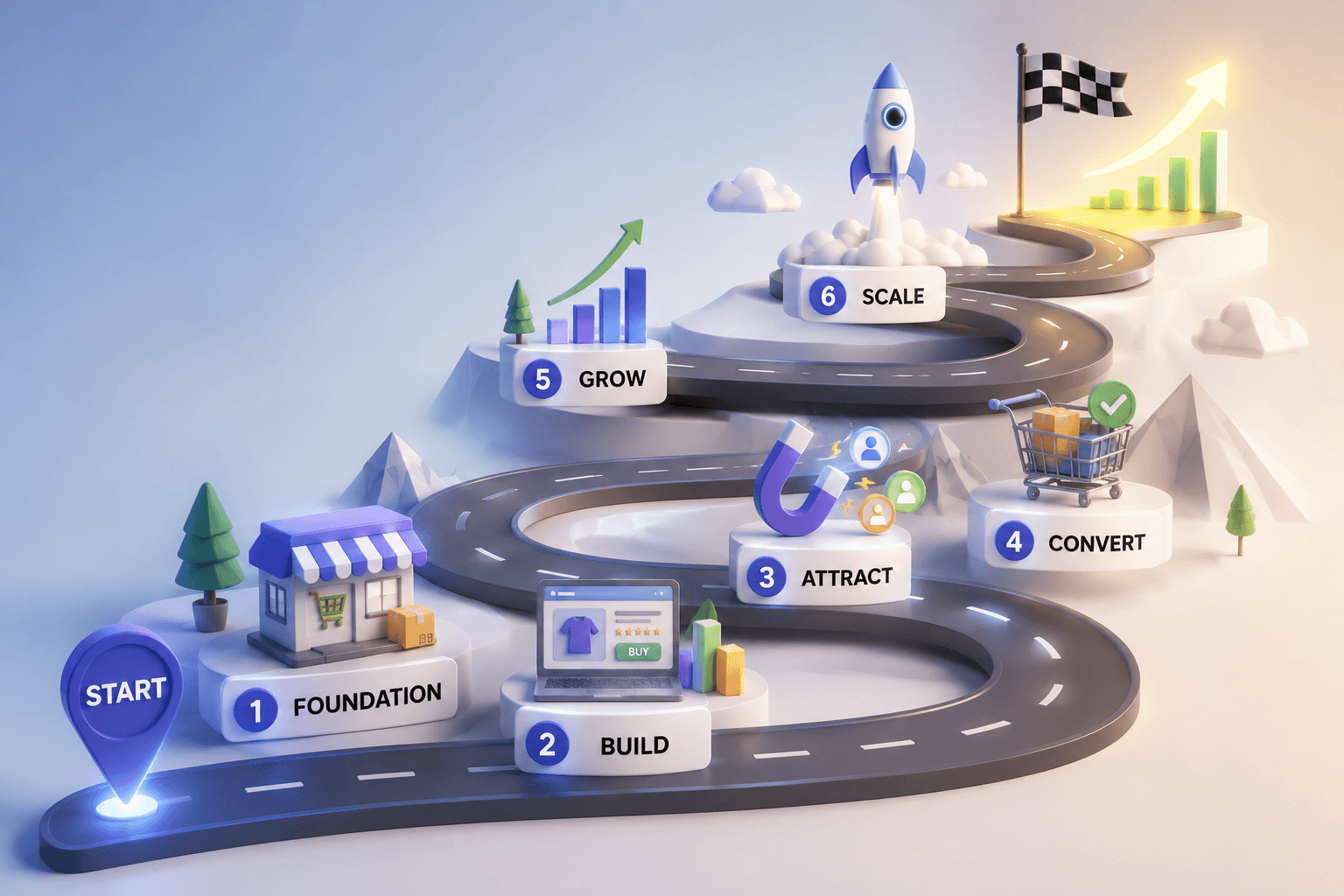
Here's a practical framework for getting your store under control:
Step 1: Centralise Everything
Stop managing your business across five different apps. Your inventory, orders, catalogue, and customer data should all live in one place. When you centralise, you stop repeating work and start seeing your business clearly.
If you're still doing WhatsApp selling alongside your website, find a platform that connects both. WhatsApp selling websites in India are becoming more common because sellers need this bridge, not two separate systems.
Step 2: Automate the Repetitive Stuff
Order confirmations, stock alerts, invoice generation, GST billing these are tasks that eat time without adding value. AI-powered online store management tools can handle a significant portion of this automatically. The goal is to spend your energy on decisions, not on data entry.
Smart eCommerce platforms for growing brands in India are increasingly offering AI eCommerce tools that handle the operational load while you focus on the actual business.
Step 3: Get Real Data in Front of You
An eCommerce analytics dashboard doesn't have to be complicated. You just need to know: what's selling, where orders are coming from, and whether your business is actually growing. Once you can see this, your decisions get sharper. Your eCommerce growth strategy stops being guesswork.
Step 4: Build for India, Not Against It
Your platform should support UPI, Razorpay, cash on delivery, GST billing, and a mobile-first experience for your customers. These aren't nice-to-haves; they're fundamentals for selling in India. Platforms made for Indian sellers understand this by default.
Step 5: Own Your Customer Relationship
Whether you're running a D2C brand, a home business selling handmade products, or a fashion boutique that started on Instagram your customers are your most valuable asset. A direct to consumer website builder gives you control over that relationship in a way that marketplaces and social platforms never will.
Sell directly to customers without Amazon or Flipkart taking a cut. Build your own brand store. Own your data. That's how you grow a sustainable online business in India.
The Bigger Picture: eCommerce Growth Strategy for Indian Sellers
Here's the truth about growing an online business in India right now: the opportunity is enormous, but the sellers who win aren't necessarily the ones with the best products. They're the ones with the best systems.
The shift from marketplace seller to independent brand owner is happening across India. D2C brands are growing. Instagram boutiques are becoming proper businesses. Home sellers are scaling to national shipping. The infrastructure now exists to make this possible but only if you use tools that are actually built for this transition.
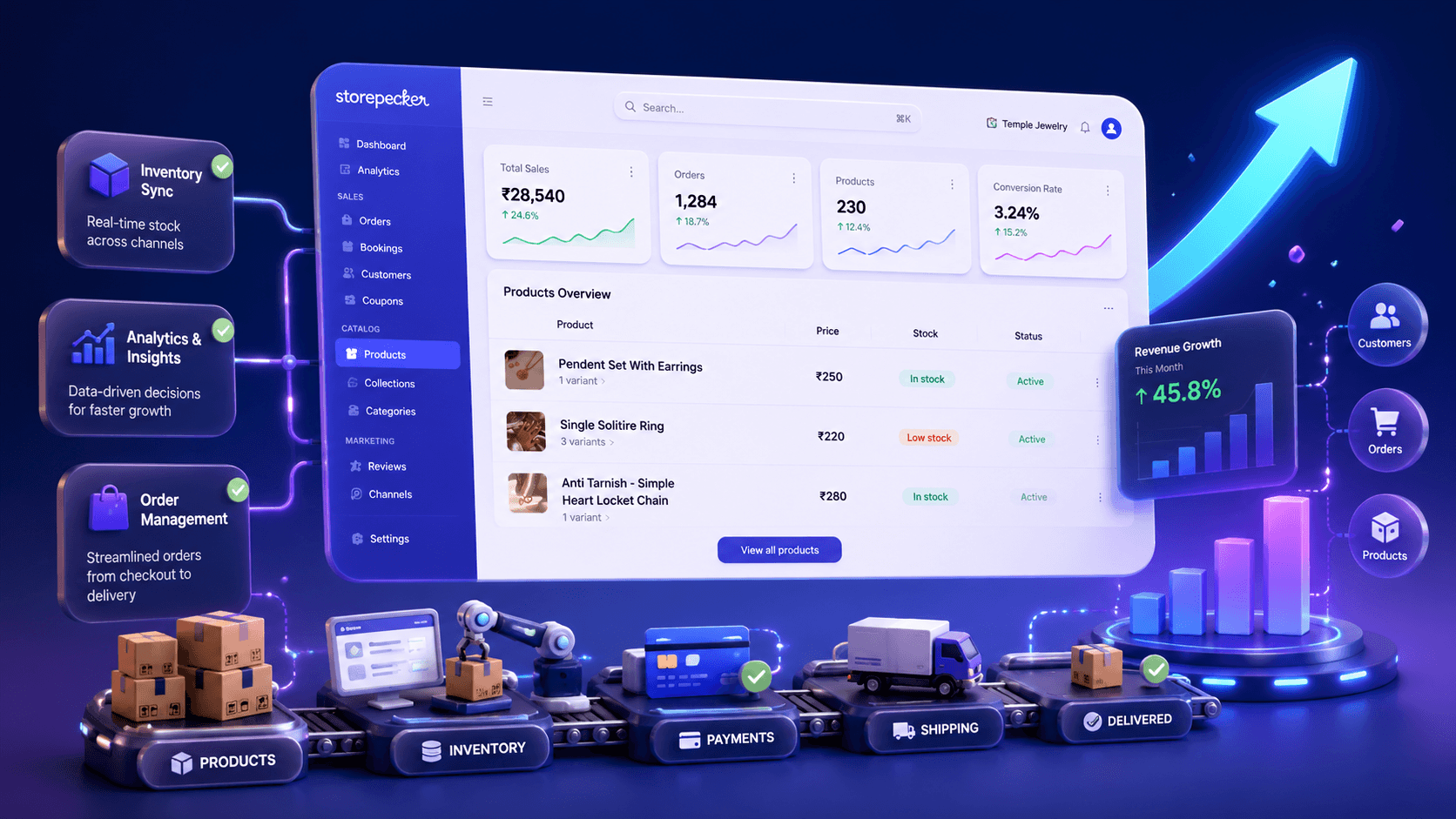
Inventory management, order systems, analytics, mobile store building, GST compliance, social media integration these used to require a developer, a team, and a large budget. Today, the right eCommerce platform for small businesses in India puts all of this in one place, at a price that makes sense for where you are right now.
You Don't Have to Keep Managing Chaos
If you've been nodding along to any of this the late nights, the scattered orders, the inventory guessing, the Instagram dependency then you already know that something needs to change.
The sellers who simplify win. Not because simplicity is a shortcut, but because when your systems work, you get your time back. You make better decisions. You treat your customers better. You grow faster.
eCommerce management challenges aren't a sign that you're doing something wrong. They're a sign that you've outgrown the tools you started with. And that's actually a good problem to have because it means your business is real, it's growing, and it's ready for the next level.
Simplify your store with Storepecker - built for Indian sellers who are ready to stop managing chaos and start building something that lasts. Whether you're moving from Instagram to your own website, scaling a D2C brand, or just trying to get your orders under control, Storepecker gives you everything you need in one place.
Your business deserves better than a spreadsheet and a prayer. It's time to make the switch.